

Life Update: I spent the last six years at Promise1 building tech and AI that supports families on food assistance or who have had their lights cut off.
Now, I run The Future Fluent (www.thefuturefluent.co): my own tech and personal advisory firm where I help companies, and the people running them, build systems where a person can arrive as themselves and the technology serves human work, not the other way around.
In June, I testified2 at Mayor Mamdani’s NYC Commission on Government Efficiency. Testifying awakened me to the power of my voice. My new entrepreneurial schedule will allow me to publish more regularly, sharing wisdom through reflections and creative writing.
Last month, my wife and I took our then four-week-old to see Chance the Rapper perform Coloring Book for its tenth anniversary.
Every millennial in that room remembered singing the same song ten years ago.
Are you ready?
For your blessings?
Are you ready?
For your miracle?
I remember exactly where I was when I first heard it. Morocco. Heartbroken. I knew I wanted a relationship. I knew I wanted to build family. The person I wanted those things with didn't want me back, and I had to sit with that, because it was a reflection of the ways I wanted to grow.3
Chance affirmed for me then that to alchemize joy, you must have clarity around what you are marching towards. That clarity will ensure you won’t miss your blessings when they do manifest. And once you grab your blessings, once that goal you were running towards is crossed: cherish it. Celebrate crossing a line, even if it’s not the final one. Don’t dissociate. Put your two hands on it! Love up on it! Have a little juke jam with it!
Coming home on the subway from the Chance concert that night, there was a woman—clearly a millennial—talking about getting got by IG ads. Maybe she went to Holy Cross. Maybe Spelman. Maybe neither. What mattered is I recognized the feeling behind the voice.
She was voicing the guilt that sits with knowing how easy it is to spend money on something we don’t 100% need. We all know that feeling. We excuse ourselves and our peers when capitalism presents something you absolutely do not need and you buy it anyway. You’ve fallen prey to being the target audience.
But I cannot deny it. My generation has normalized this. Arguably song of the summer: Spend dat sh*t.4
My peers in tech were in college between 2005 and 2015. Many of us vested. Many more of us did not see our slave labor and the relentless grind culture of Silicon Valley turn our fictional equity into real spending power.
I remember hearing early Uber and Twitter stories before Travis and Elon were breaking news. I remember friends showing me Palantir’s nap pods years before they became synonymous with ICE. My peers were entry-level, slaving away at a NerdWallet because we believed in the freedom of information — the promise that people might finally understand the consumer finance our parents never taught us. And as our equity vested, learning what capital was became survival. If we also wanted to afford bottle service, we had to learn what equity was. What credit card points were. What high-yield savings accounts were.
Then suddenly we had disposable income, and nobody taught us what we were disposing of.
We learned to call rest, resistance.5 Nobody taught us a word for what money represents when it is still in transit to becoming a material thing.
Let’s make one up.
Money should represent what you are most delulu about wanting for yourself.
The fact it can be so hard to resist the pull of a targeted ad is just plain delulu. I can’t imagine what our ancestors would say. Next time, you’re scrolling about to double tap ApplePay to buy in one-click, you should check in on what you are committed to. I left corporate and am forgoing the security of a W-2 with a newborn in the house. So don’t come at me about delulu.
But next time you’re about to add something to your cart, what if you were immediately able to visualize that exact delulu dream? What financial goal are you building towards? I believe money should actually represent that commitment. Name that goal. You should be committed to something. You should be able to name what that something is. As soon as you can name the goal, you can assign that commitment a value. And the value of that commitment should be delusional.
Suddenly, your individual choices and relationship to money is connected to a bigger destiny.
That’s the beauty of mythology and quite possibly the only antidote to really fucking good marketing.
To build wealth of mind body and spirit, the value of what your non-liquid and liquid money represents must be delusional.
Over the last year, I’ve been reflecting on my crazed and relentless drive to build a home.
I was seventeen when I understood the arrangement: work this hard, tell the truth, survive this much, and still have to pay to stay alive in somebody else’s house.
For years, I lived in beautiful places that didn’t want me whole. I made conference rooms my stage because Black bodies were expected to be construction workers, not possibly students, nevermind a community of Rhodes Scholars at Oxford.6 I made Airbnbs my escape. I lived in efficiency apartments and called it ‘sacrifice.’
Some forms asked for my mother’s name and returned Ward of the State of New Hampshire instead. That was the language available for who I belonged to. Not daughter. Not child. Ward. State. New Hampshire.
I know the spiral of not belonging intimately. I still carry the weight of contorting myself for years. The rewriting. The relisting. The month to month lease. The sublease. The bag packed the night before. The rental backup plan for the backup plan.
Then I signed and suddenly I have a permanent address. The day we closed, I sat in the car and shook. Nobody told me relief comes with grief still attached to it.
Now I write from my living room. The sounds of Brooklyn outside—kids biking on the corner, men yelling across blocked traffic, music bleeding through cracked windows—remind me I’ve always belonged to a people who never needed perfect enunciation to tell the truth.
We live one block south of newly-gentrified Bed-Stuy. It’s central Brooklyn, some of the few pockets left that aren’t curated or endangered. Just Black, loud, layered, alive. We moved here on purpose. My forever home sits here on purpose. And when I walk through it now, I don’t feel like a visitor.
We designed this house around joy. Around rhythm. Around return. This isn’t just interior design. It’s the interiority of survival made visible. It’s what happens when Black women get to keep what we build.
1. Name the shame
But these admirable choices find me in a new season. Where I traded the tyranny of unstable rent for mortgage payments. The catch: the system outwardly rewards homeowners with security; however, our new real estate investment has us confronting a different reality.
“House poor means you own a home, but you are stretched so thin financially that you can barely afford anything else,” says personal finance expert Andrew Lokenauth. “The mortgage is paid, but things like car repairs, medical bills, vacations, and retirement contributions all take a back seat. You have an asset, but you have little breathing room.”
HUD’s line is 30%.7 Spend more than that on housing and you’re cost burdened.
In 2024, one-third of American households—about 43.4 million8—cleared that line. Now look at who. Harvard’s Joint Center for Housing Studies put it at 22.7 million renter households.9 12.1 million severely cost burdened, paying more than half their income for shelter.
Renters earning under $30,000 had $210 left for everything else.
Affordability is only getting worse. Half of all renters are standing exactly where I’m standing—moderately to severely cost-burdened.
As the cost burden rises, our collective consciousness for empathy and community at all income levels must faithfully follow. We need more models of embodied money talk in the working class. Instead, I actually actively observe how the system and its lackeys deploy American Dream mythology to demonize and obfuscate systemic realities designed to prevent upward mobility.
Nine years ago a property mogul worth $465 million went on television and said millennials couldn’t afford homes because of avocado toast.10 This attempt to call out my generation for spending far too lavishly day-to-day to afford a home, while older generations saved money in order to invest in a home, very devilishly obscured the reality that wages had, for decades, decreased in relation to their cost of living.
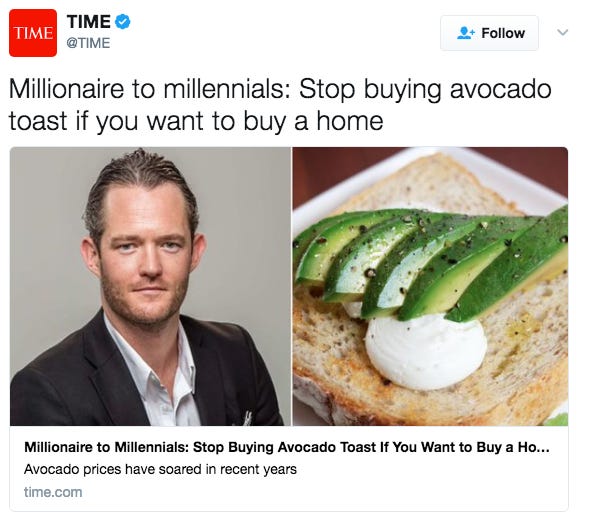
Six years later he said unemployment should rise forty or fifty percent so workers would remember their place, saying “we need to see pain in the economy. We need to remind people that they work for the employer, not the other way around.”11 Even former US Treasury Secretary and President Emeritus of Harvard University Larry Summers argued in 2022 that unemployment had to rise to bring down inflation.

But here’s my confession. I am wrestling myself to actually give up the “f*ck it we ball” mindset. The $18 cocktail. The VIP ticket instead of general admission. This season of reining in my spending has not looked pretty. But one Barclays Center Liberty game at a time, I’m watching myself make a different choice. I am choosing the free seltzer instead of the one $16 beer—and honestly, I was only having one drink anyway.
And it is here I must also be honest and self-compassionate. The choice to not spend frivolously is hard and most days, it still does not feel easy.
In fact, every time I open DoorDash, I’m internally cosplaying the disciplined mom who stays in and cooks instead of ordering out and then eternally disappointed in myself if I still choose to follow through.
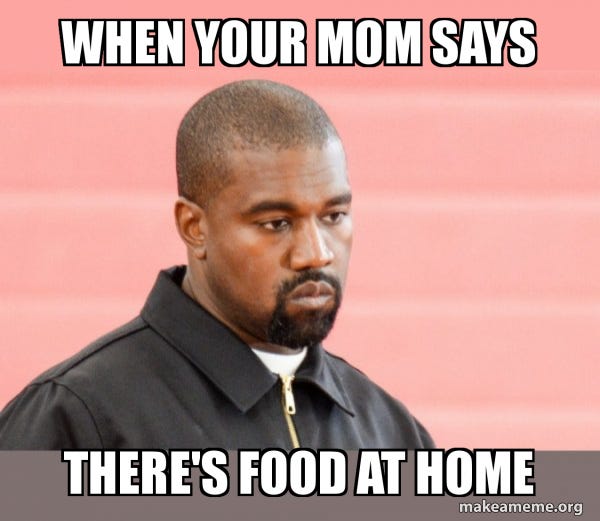
Sadly, this version of mom ain’t me yet!
The reality check is that my discipline to not spend money will come after I acknowledge and tend to how much it hurts to feel left out.
2. Feel the feels
Money is weird because it’s something we just were never taught to be in community with. It hurts to be the one who doesn’t come to dinner because you can’t afford it. To watch friends play credit card roulette for the check. To hear about points stacking on the Sapphire Reserve. To go from being the planner of the international bestie trips to now watching the Instagram stories of those same besties from my couch while they are on the other side of the world.
The American Dream has also taught us to keep these hurts to ourselves. Conditioned to assume it’s bragging to name any context around why we might not be able to follow through on a plan, as it relates to fluctuating finances. The internalization of imperialism and capitalism begs me to feel like a failure. And I pinch myself anyway in awe I even made it to the position to have the good credit and cash reserve to even afford that Double-Income-No-Kids millennial lifestyle in the first place. It was a privilege to budget on vibes. To reluctantly pass on plane tickets I previously could afford makes me feel shameful.
I can feel how deeply this ache of FOMO lives in my body. Actively choosing to miss out on fun adult activities activates many years of trauma from living in poverty. The type of poverty where you are robbing Peter to pay Paul; playing roulette to decide which bill gets paid. Is it the rent or electric bill that gets paid or is it the fridge that gets full? The reality of which barred me from participating in many fun childhood activities. The 35-year-old version of FOMO has me yearning to prove to myself I am not the same little girl getting made fun of for wearing high-waters, scouring Goodwill, and shopping for back-to-school shoes at Payless.
As a kid on food stamps, I skipped meals so my younger brother could grow stronger. I knew I needed to be strong for him and not complain. This means I hid my cries, ignored my tummy’s cries and buried the grief I couldn’t even name out loud.
Now I find that same hurt and powerlessness itching to return. Creeping up just below my conscious. But this time, I’ve come to actually reach down and invite the grief out of the shadows of my subconscious and sit squarely in the light. From the light, surrounded by tenderness and care, I begin to notice this grief sits right next to deep relief.
$18 speakeasy cocktails are a luxury I’ve worked incredibly hard for. Nationally ranked in chess by the age of 12, co-captaining the Villanova Women’s Basketball team as a walk on and later graduating from University of Oxford with my second masters degree as a Rhodes Scholar doesn’t happen overnight.
Executing with elite executive speed and honed discernment led me to a lucrative decade-long career in tech. There, I built venture-scale architecture and amassed practical technical, product, and AI fluency.
Scaling financial inclusion forced a macro shift in the remittance industry, what I call the Sendwave effect, where digital-first competition disrupted legacy giants like Western Union and MoneyGram to adopt low-fee, mobile-first models due to lower profit margins.
My reward for being an early builder: I could invest in a mortgage and finally lay down roots for myself, my wife and my two daughters.
Yet, the cold reality of credentials and accomplishments is the material successes they afford do not keep your soul warm at night. I find the same temptation to sit in grief alone, ignore the relief of my hard work and resort to base retorts like I should have known better.
There are parts of me that want to protect my ego and reach for excuses for my grief. These parts used to echo that I can’t share that I feel grief because I am a smart adult who made choices to be in a cost-burdened position.
Writing this essay changes that for me. I push back. Society’s dominant narratives cannot teach us how to collectively be in community around money. This is because American mythology requires rugged individualism. My immigrant parents were just trying to make it to give us a better life. They couldn’t teach me because poverty had their own ego and shame in a vice grip. So of course, if I refuse to name the grief because it’s the consequence of my own adult choices, I am continuing in that lineage of shame and rugged individualism.
This essay is my way of saying fuck that. The internalization of a dream that isn’t even mine and doesn’t serve me or where I want to go is a hard no for me.
Join me. It takes a lot of practice, but it is possible to be in conversation and community while navigating the contours of resource constraints and without making it an oppression olympics. I am choosing to acknowledge my new condition of house poor by holding multiple hard truths in my same body without letting myself become poor-minded.
That’s what feels so different and empowering. Some days I do watch myself name without shame to friends I’m pulling back on spending. It has felt weird, but not weird as in awkward. Weird as in an oversized sweater I swore I felt confident in when I tried it on in the store; but now when I put it on at home, I’m just not sure. When I feel relief, the unease melts back. And every time I practice naming how cash flow is tight, more ease comes back, giving me the confidence to stand in my truth again the next time.
Writing this essay also means that I am secure in myself that making the choice to skip the besties trips doesn’t mean I am morally superior and somebody else is spending unreasonably for going.
3. Don’t accept. Acknowledging breeds action.
I invite you to join me and each other in collective grief and relief. In this wisdom to hold both truths, I’ve built a practice of safety to feel through the carnivorous shame of poverty and the grief and relief that arise. This is safety I have always deserved and you deserve it too. It is a safety that was never offered by the American dream.
Why? Because the mythology of the American Dream is dead. Today, for many, feels so heavy and directionless because we were not raised with practices to be in collective care and dialogue when we are grieving.
But I am not lost. I deserve to be seen in all my grief while moving beyond the myth of the American Dream. My lore doesn’t rely on rugged individualism. My unshakeable confidence is not reliant on a belief in hyper-independence. My acknowledgement that I feel constrained by the conditions of my present moment is what unshackles me and motivates me to build the world I want to see.
What is in this world?
Gratitude and community are the core of my mythology and why I feel so passionate about the future. I do not derive my value, my humanity or reason for feeling alive from the present moment of feeling cost burdened and resource constrained. I am fully me, independent of my resource limitations. I thank my ancestors, their lineage. I’m in their line. I am their wildest dream. I am their wildest imagination.
They whisper, “What’s the worst that is going to happen? You have so much to be grateful for.”
So on the days and moments I do sit long enough, I have the room to really embrace the relief I found home. Not just any home, a radiant beacon of hope, possibility, promise and comfort. My wife. My two daughters. The grit and tenacity of Crown Heights neighbors.
In ten years, my daughters will be able to triangulate what schools are walkable or what schools are worth taking the subway. Which fast and free bus lane gets built next has become personal. I am invested in Mayor Mamdani fixing all of NYC’s potholes. Because it is that pothole I drive over every day to get to the things I want to get to.
Maybe American politics became such a performance because a majority of voters had slipped out of community, and were mesmerized by the idea of it. Voters who are not buoyed by tangible neighbors find these tales of what life could be romantic. And now people are tapping back in and noticing living in America is unaffordable and there is no vision for where we go next and what we bring with us.
I’m committed to my community. My values are liberation and deep joy. Living my values at their fullest challenges the notion that being house poor is a bad thing.
In this new season of living an embodied, liberated life, I want the language I use to redirect my attention to what I am accountable to. It is important to direct my energy and efforts toward building what I actually want to see more of. I feel cash-capital constrained and abundantly resourced. After months of being in practice with both the intention to make more aligned day-to-day spending choices and feel the guilt and shame around that spending, I am noticing the shift. Missing the magic of traveling with my snowboarding community12 and acknowledging the sadness that I can’t join them as they head to Finland this winter doesn’t have such immense, debilitating power over me.

The loosening of power over is the accepting of power within.
Now, I compost the FOMO energy into opportunity to look for more creative, affordable gifts to conjure. The giggles of our two children light up my whole world. Community day is Thursday at the Brooklyn Children’s Museum. Free.99 public parks and playground hopping was the move this summer.
From the comfort of my gorgeous green kitchen, discovering that I can combine my Nespresso machine with my mixology skills to make one mean shaken cold-foam iced oat-milk latte has been the move this fall. With that deliciousness in hand, I both have the courage to say no to the $9 coffee shop latte and I have set myself up for success to be proactive when it comes to shifting my spending habits.
The freedom that comes after feeling your feels is action. I reparent myself by taking my time to better set myself up for success. This means leaving the house full or packing a lunch to be better resourced to say no to a tasty treat or when faced with another day-to-day decision that a previous season of my income could have withstood. I take this same energy to reflect on gifts left by our ancestors. I look to them, and their words, and their wisdom.
One of those ancestors is Nikki Giovanni.13 She died on December 9, 2024.
Being Black and poor is, I think, radically different from being anything else and poor. Poor, to most Blacks, is a state of mind. Those who accept it are poor; those who struggle are middle class.
— Nikki Giovanni
Sacred cows-- and other edibles (1988 edition), William Morrow & Co
What I take away is you can qualify for food stamp assistance. But your mentality once you’re on it is what will define your blessings.
So y’all, I will not police your use of “house poor”.
But I am choosing to lay down the grief and shame I internalized from growing up impoverished and step into my power to recalibrate my day-to-day choices to make a 30-year-mortgage commitment to own Brooklyn real estate feel more abundant.
My internal dialogue is now I say house committed. Because in my house, I’m free. I’m liberated. I manifested my forever home and I am committed to the consequences that come as a result, positive and negative.
Most importantly, I’m not finished moving through the grief of becoming house committed. I’m in practice with acknowledging I can live abundantly during my season of returning to being cost burdened. And like every season, one thing that always stays the same:
Seasons change.
At Promise, I spent six years building government technology to serve the everyday people software has always left behind. Working with SNAP recipients in Mississippi to reduce burden on both families and program staff as a response to O.B.B.A (H.R.1 Work Requirements) was one of my most impactful projects during my tenure: https://www.promise-pay.com/resources/how-mississippi-deployed-h-r-1-work-requirements-in-8-weeks
TL;DR: My testimony was about the line I pass on my way to drop my daughter off at school; neighbors standing in the street every morning to prove they still deserve food. Sitting in traffic has become a monument to that inefficiency every single day: https://www.businessinsider.com/what-nyc-thinks-of-zohran-mamdani-efficiency-effort-coge-savings-2026-6
I kept a blog and published my reflections during my 2016-2017 Peace Corps stint too: https://ajournalforthefastlane.wordpress.com/2017/04/14/so-what-exactly-am-i-doing-in-morocco-six-month-reflections/
I really love this song. More on the song’s controversial lyrics here: https://parlemag.com/2026/07/spend-dat-controversy-yung-miami-india-arie/
Tricia Hersey, and the Nap Ministry, has been a formative guide to me and others who are recovering perfectionists and overachievers learning to reparent our relationship to rest: https://www.instagram.com/thenapministry/
Most people have a hard time processing that for as lofty as being a Rhodes Scholar sounds, being Black at the University of Oxford sucked. I am so proud my boy Field Brown had the courage to say why: https://www.cherwell.org/2014/10/31/allegations-of-racism-made-against-christ-church-porters/
This article does a great, simple job of explaining “house poor”: https://www.rocketmortgage.com/learn/house-poor
The data is so rich. I recommend engaging with the entire study: https://www.jchs.harvard.edu/americas-rental-housing-2026
But if you’re short on time, this is a great summary of the report’s highlights: https://novoco.com/notes-from-novogradac/harvard-jchs-state-of-the-nations-2026-housing-report-highlights-ongoing-housing-affordability-pressures
The internet rightfully flamed Tim Gurner for being so out of touch with the reality of the rising cost of living: https://www.cnn.com/2017/05/15/news/millennials-home-buying-avocado-toast
Good summary of when the out of touch millionaire tried to stay relevant: https://www.vice.com/en/article/the-original-avocado-toast-millionaire-is-back-and-he-wants-pain-in-the-economy/
I miss snowboarding with my frands!! I wrote about why it’s so magical to experience social rest here: https://blog.thefuturefluent.co/p/rest-as-a-skill-part-1-social-rest
May Nikki Giovanni’s memory be a blessing: https://www.pbs.org/video/nikki-giovanni-1733870018
I’m coming over for one of those shaken cold foam oat milk lattes!!!