

The first time I ever left the country was summer 2012 to Serbia. That summer, I took a bus to Mostar, Bosnia and then drove north; up the Croatian coast from Dubrovnik to Split, falling deeply in love with the Adriatic Sea. Though I’ve now lived, studied, or partied in over 50 countries, places that make me feel most alive are at the intersection of a mountain and large body of water.
The bountiful horizon, the rush of the ocean spray, and the calm, restorative groundedness of a deep blue all working in tandem to quiet my ever-racing mind.
And yet, just like an interdependent couple, two people fully whole and grounded in themselves who come together and become an even bigger, more beautiful version of themselves; it’s the immodest, grand rising of an imposing mountain greenscape declaring an “I am also here” that exponentially stills my spirit.


The majestic ocean is my friend. The marvelous spires are my friend. Blue and green. Both and.
With these paired vantage points in the same breath, I’ve come to hold sacred when a natural landscape is dichotomic, so much beauty in its diversity. Classic Gemini behavior, I guess one might say, but I am devoted to the feeling that anything is possible with choice at the center of the why.
In the first essay of this series, I mentioned I start with one question before I use AI: what do I want?
Starting here is paramount for two reasons:
Without understanding what you want, you will hand AI your judgement, your memory, your curiosity, and your critical thinking. The moment you stop using these abilities, they begin to atrophy. We can’t survive as a species without these things.
Without understanding that systems come with their own defaults, AI will impose its defaults on the thing you want, often morphing away from what you actually wanted. You will deploy AI carelessly, trust it blindly without question, and point it at problems it was never fit to solve.1
Thus what you allow AI to create, change, generate, or destruct will ALWAYS reflect what you value.
The following is what it looks like for me to trust AI when the thing I want is my joy.
NOTICE what the system wants
When I went to plan my 33rd Jesus year birthday, I sought to curate a trip that would honor all I hold sacred when it comes to travel. It may not surprise you that I proposed to my now-wife in St. Lucia, a week enveloped by the not-so Petit and Gros Pitons piercing the southern coast and sun-kissed by a picture-perfect backdrop of cerulean waters and robin’s egg blue skies.
A group culinary food tour in northern Portugal had me briefly consider handing over my bougie tastes and type-A personality to a boutique travel agency. The trip’s package included: private five-star rooms, all locally produced meals cooked with the wisdom of centuries-old recipes, and each tour stop meticulously planned to honor the rich history of the Porto, from wine-making in ancient wine cellars to tasting olive oils, vinegars, and fine cheeses.
The catch? A Sunday deadline to say yes because there was a waitlist. It was a beautiful concept. However, the price tag made its possibility much more a fever dream than a reality for most of us. As I put it to my friends over email that December:

The reality was ultimately that trip was built around someone else’s idea and budget. Micro-culinary food excursions are an entire commercialized ecosystem, where tour companies profit from: curating a repeatable version of the “perfect getaway”, leveraging relationships to increase margins, minimizing for the spontaneous and personalized, and optimizing for the most accommodating and generalizable.
Take note, because all the mainstream AIs being pushed for personal adoption repeat this strategy.
My first reflex was to ask the default to bend to me. I recognize that reflex now. I feel it rise every time I open an AI tool and I think AI messed it up. It’s AIs fault. AI did it bad. Not me.
This is the instinct to negotiate with the default instead of stepping back from it. To externalize the blame, rather than recenter my own power. Ultimately, AI is a mirror. The willpower to put my efforts towards understanding exactly what I will not sacrifice requires extracting myself from using the default’s configuration as my starting point.
Frankly, I had been on enough of these pre-packaged group tours to know exactly what would make my 33rd birthday trip sacred.
DECIDE what I want
By then I had Strat-Doul, short for Strategy Doula. My AI of choice was a custom GPT using OpenAI that I’d been shaping for years around how I think and work. Unfettered, we were going to round up possible mountain-beach destinations and create a week-long itinerary that accommodated 12 queer travelers who love to swim, hike, relax, cook and drink.
No, that was not the prompt.
In fact, I didn’t open any AI tools at first.
The first curated trip to Portugal sounded amazing, but I forced myself to articulate what exactly felt amazing. I was to untangle which parts of that expensive-ass trip I could do without or needed to reimagine.
Taking a step back to reflect can look circular, trading emphasis on outcomes and efficiency for curiosity and slow time. And as someone who likes to move fast, I find it hard to prioritize time for reflection.
But I was not deterred.
I asked myself, where do I feel joy? What did I most desire for my 33rd bday celly? I ended up sending my friends via email more of these reflections on New Year’s Eve:
is it the place, the people, the specific Portugal experience? what will be the true purpose and intention of this gathering? and what conditions would best fulfill this vision?
I arrived at: unbridled joy is at the core of my birthday vision.
If I’m surrounded by homies I love, who love me, who love to swim, and who love to 🎶drink all day because we can start in the morning🎶, I’ll be perfectly content.
I wanted all of my homies, who live in different places and who I see at varying levels of frequency (but mainly not enough), under the same roof for an extended period of time.
After gathering this picture of my ideal vibe, I did what any futurist does best. I worked backwards from the feelings, breaking the vision into discrete, measurable goals.
To drink all day, we need a good fridge, spacious kitchen, and multiple indoor and outdoor lounging options.
To eat good, we need working appliances, an outdoor grill, dining seating areas, and easy access to quality produce and proteins.
To swim free, we need fewest barriers to access to luxuriating waters, which can include but is not limited to beaches, hot tubs, infinity pools, lakes, rivers, rafting, kayaking, boat cruises, or renting a yacht or catamaran.
Next, I stack-ranked them in priority order.
The spot must have warm weather in June and be connected to major airports. Hot tub is a bonus. The moonshot is an infinity pool. Every bedroom having its own private bathroom is non-negotiable. If we pay for a chef or private grocery delivery, it must maximize value by taking into consideration the unit economics of feeding 12 people for over a week. Location needs to account for roundtrip time to airport, although optimize for comfort and amenities of villa over closeness to airport. Any excursions need to include full transportation and rest days on either side.
Then came the second-order questions, the ones nobody asks until they’re standing at baggage claim.
Twelve people flying from different cities on different airlines will land at different hours. Who is waiting at Split airport, and for how long?
If everyone has to pay me back in one lump sum, who quietly decides they can’t come?
What does someone need on their phone when there’s no signal at passport control?
What happens to a budget built in USD when the euro moves or the taxi costs more than the website said?
This line of questioning minimizing for downstream consequences is always missing from AI’s default configuration, as AI is programmed to reward for solving the surface-stuff quickly.
Hence, I didn’t ask AI a single research question until I knew what I wanted.
PROTECT the difference
Once I chose Croatia, here is what the AI actually did and how I remained in the driver’s seat, even when AI worked autonomously:
I built the budget line items by hand. Strat-Doul suggested budget ranges.
I composed my custom Google Sheet with the house, the experiences, the airport transfer, a food line, a currency buffer, extra taxis, and an estimated slush fund for whatever I hadn’t thought of yet. I demarcated unknowns with question marks to make it off limits to AI. Strat-Doul was instructed if the row is sitting there with a question mark, skip it until it has stopped being unknown.
The structure, the buffers, and the decision about what each friend would owe were mine, and the number we landed on, $1,860 a person, came in under the $2,000 budget I’d floated to the group for a custom version of the Portugal trip.
I built a price-tracking tool inside Strat-Doul and watched flights for two months. It felt GREAT to email everyone it was time because my conviction came from evidence that didn’t require I pour loads of cognitive effort into tracking.

AI tools aggregated villas on the platforms they could find. For any villa with potential, I took the same villa and conducted my own independent search.
All travelers should be wary: nearly every rental property advertises on multiple third-party platforms, from Airbnb to super, duper obscure niche sites.
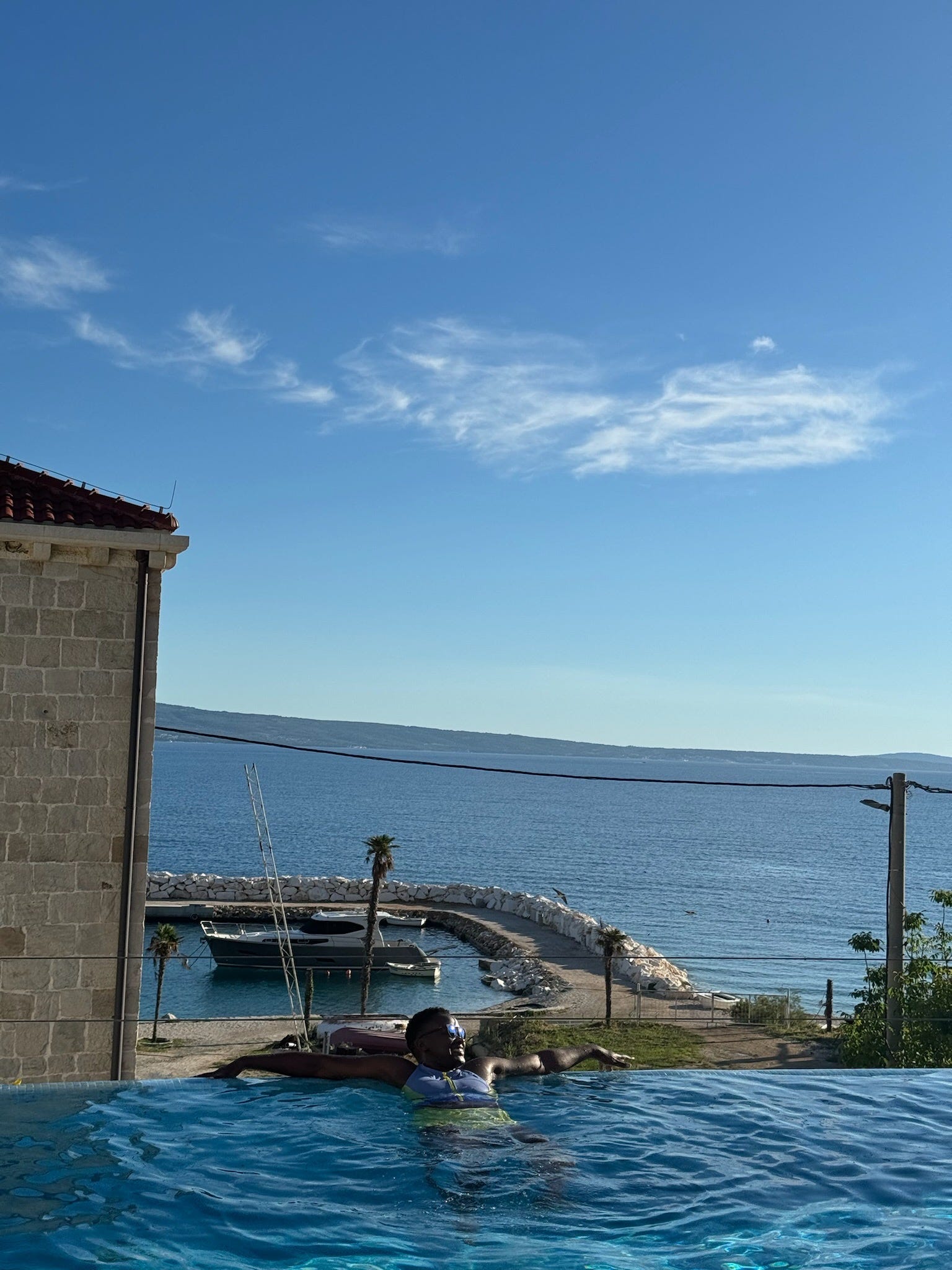
I landed on a stunning, Grecian 3-story, 10-bedroom villa with an infinity pool directly across the street from the seashore of the Adriatic Sea.

Why could I trust my AI tools?
I shared with Strat-Doul that mutual aid, accessibility, and divestment from groupthink are my values.
Strat-doul was empowered with both my trip’s context from my Google Sheeg and access to search tools with guardrails on which types of assumptions it can make from the context.
At each milestone, Strat-Doul could more accurately and more quickly aggregate first-draft emails for time-sensitive actions and logistics minutia. I relished the time saved to communicate all the nuts and bolts to different types of communicators, knocking out the laborious parts of keeping different learners and traveling styles on the same page.
And most importantly, Strat-Doul wrote first draft emails that sounded directionally like me. I shared my most effective communication techniques for herding cats, directing emails to reflect bottom line up front, to highlight any urgency around time-sensitive requests, to imbue my comfort with installments, to relay that attendance is flexible for excursions and to put an emphasis on free time.
With time-saved on the first draft, I put my extra time towards crafting the final versions to sound just how I wanted.
Strat-Doul wrote: “Please input your flight details here to help us coordinate arrivals and logistics seamlessly.”
I sent: “Please add your flight details here to help me secure group airport transfers based on clusters of arrival times for those who want them.”
Strat-Doul wrote: “Payment plans are available on request.”
I sent: “Installments are totally fine for getting me the full $1,860, just reach out.”
Strat-Doul wrote: “Volunteer to coordinate our yacht day outfits!”
I added: “No pressure, only possibilities :)”
Strat-Doul wrote: “Make our flight tracker available for offline use on your phone.”
I sent: “Make our flight tracker available for offline use on your phone to avoid shitty airport wifi/shotty cell & data service. Bonus is it will also save you a ton of time filling out any Croatian Arrival Customs Forms with everything in the same place.”
Strat-Doul wrote: “Make sure to carry some cash for small purchases.”
I sent: “Highly recommend stopping at the ATM in the airport, not bringing dollars to exchange for the best conversion rate.”
Every one of those edits was a decision the tool couldn’t make, because it didn’t know these 12 people, their budgets, their flights home, or what makes each of them feel welcome. It handed me a clean, generic draft at speed, and every change I made was me getting to be more myself in front of people I love.
WHY THIS MATTERS
I am determined to win the imagination battle for a positive future with AI.
However, AI can be exhilarating, daunting and downright frustrating all at the same time. It often won’t “work”. And if you’re holding a mirror up to it with honesty, you will hit its limits quite quickly because AI cannot solve most things on its own well. There’s the other truth too: when it works, the shame of admitting it wasn’t all you creeps in.
Noticing what the defaults are and using THAT as an opportunity to pause and figure out what you want is the key to a positive future with AI that is full of integrity.
Most AI benchmarks measure what models can do. Last month, MIT Media Lab released what it calls the first open benchmark measuring what AI does to us: its impact on human well-being across physical, psychological, and societal dimensions.2
I ran the same test at the scale of one birthday. I measured what I wanted before I measured what AI can do.
The result?
I offloaded logistics to an intentional AI to do the heavy lifting. My friends and I didn’t have to spend our cognitive load on figuring out who was picking up whom or how much cash to carry. I also am completely cool not using my brain to check prices daily. I hate that shit.
On our last full day, after the winery, a motorboat carried us up the Krka waterfalls in the late gold light. Pale limestone peaking over the green slopes, caves worn into the rock-face, and the winding river under us too turquoise to be real.
Tier after tier of white water pouring over the travertine, the white or light-colored calcareous rock deposited from mineral springs was loud enough that we all stopped trying to talk. A rainbow hung in the spray. As each of us took our turn to pose, my wife pulled me in against the wooden railing and kissed me. I squeezed my eyes shut, breaking the kiss only to smile wide for the little happy birthday girl in me.
The mountain was my friend. The water was my friend.
And nobody asked me where the car was or if we had to coordinate Ubers. It was already booked and sorted.
This is the second essay in a series re-imagining what technology can be used for. Over six parts, I’ll show how I actually work with AI: goal-setting, context-sharing, iteration, feedback, refinement, reflection. Next up, context-sharing.
Use AI to actually learn some shit, while staying you.
By the end of the course, you will feel what it’s like to have your voice heard by AI.
If you’re curious about what AI is programmed to be good at and bad at when it comes to human flourishing, check out the great work they are doing over at MIT’s Media Lab. From their homepage, “Advancing Humans with AI (AHA) is a multi-faculty research program that investigates the human experience of pervasive AI with the goal of designing human-AI interactions that promote human flourishing.” https://www.media.mit.edu/groups/aha/overview/
ImpactBench (Open Benchmark of AI Impact on Humans), MIT Media Lab’s Advancing Humans with AI program with UC Berkeley Haas, USC Marshall’s Neely Center and the Psychology of Technology Institute, launched October 2026: https://www.media.mit.edu/projects/impactbench/overview/